
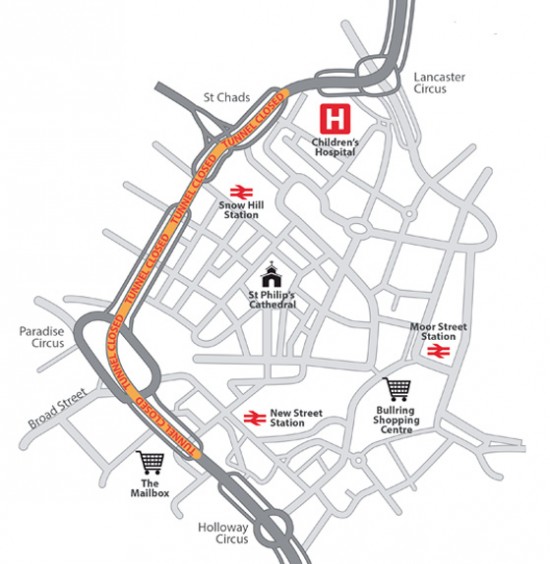
The Birmingham city centre A38 Saint Chad’s and Queensway Tunnels will be closed for six weeks from 19th July to 2 September 2013. But why does Birmingham have this partial network of tunnels and why has the inner ring road been in a state of flux for 70 years?
Building the inner ring road demonstrated Birmingham’s ‘can do’ attitude, and love affair with the car, but was it the right vision for the city? It swept away the old street pattern and many splendid Victorian buildings.
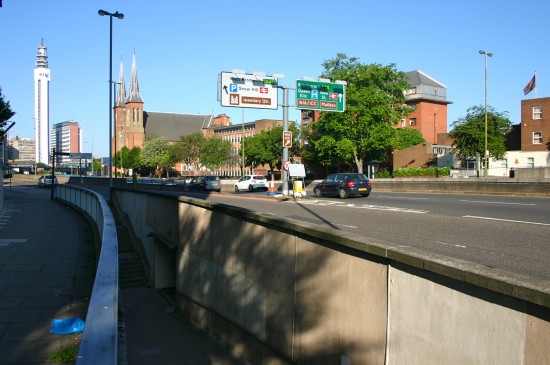
The approach to Saint Chad’s Tunnel.
Sir Herbert Manzoni (1899 – 1972), was Birmingham City Council’s chief engineer for 28 years and he began planning the city’s inner ring road in 1943.
Manzoni was a follower of the modernist architect Le Corbusier, who saw the car as king. They believed pedestrians should be segregated away from roads, and that nothing should impede the flow of traffic.
Manzoni saw little of value in Birmingham’s Victorian heritage. He swept away the original Birmingham and Midland Institute, built by Charles Barry in 1857. It included the conservatoire and was at the heart of the city’s cultural life. Today the building would be regarded as a masterpiece.
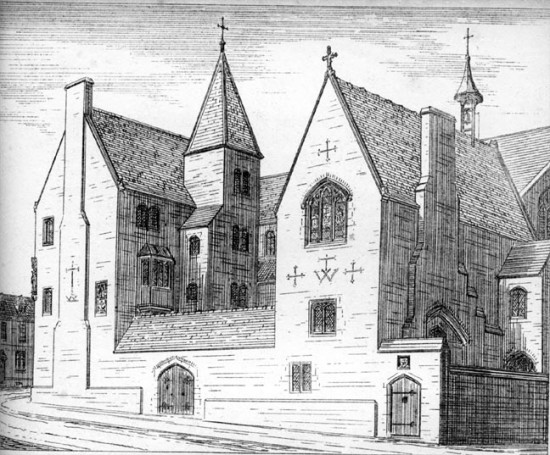
The Bishop’s Palace, built by the Gothic Revival architect Augustus Pugin in 1840, was also swept away. Manzoni wanted to demolish St Chad’s Cathedral itself, also by Pugin, but it was saved by one vote at a full council meeting.
The Bishop’s Palace, by Augustus Pugin, demolished in 1960.
(Quite recently, one of the Gothic ceiling lights from the Bishop’s Palace was auctioned at Bonhams, with an asking price of £15,000. It had been previously purchased by the star Cher for her Malibu home).

Saint Chad’s Cathedral by Augustus Pugin, (joint architect for the Palace of Westminster), was spared.
Manzoni completed Birmingham’s inner ring road in 1971. Almost immediately, car manufacturing in the city went into decline, there were great losses at British Leyland, and a massive recession followed. Between 1971 and 1983, 29% of all jobs in the city were lost.
Road dominated city centres found it difficult to attract new service sector investment, and Birmingham went into decline.
But then in 1988 Birmingham’s Highbury Initiative was about getting the right vision for the city. Crucially, it began with a period of consultation. An international symposium was held where the best international advisers on city building were listened to, and local people were also listened to, rather than the voice of one engineer.
It was realised that the inner ring road was acting like a concrete collar, preventing the city centre from growing, and its brutal appearance was harming the image of the city.
In 1991, just 20 years after it was completed, work started on dismantling the inner ring road.
The 1988 Highbury Initiative resulted in a new city centre design strategy that began the process of giving streets and squares back to the people of Birmingham.
Investment in people-friendly public spaces attracted new companies, and then in 1998 Birmingham hosted the G8 world summit, attended by the US President Bill Clinton and Prime Minister Tony Blair. The year after that, Birmingham captured 42% of the entire UK conference market.
Today, the St Chad’s and Queensway tunnels are the last bit of the inner ring road to remain. For pedestrians, they still cut the city centre off from the Jewellery Quarter because of their wide feeder roads at surface level.
The six week closure of the tunnels will no doubt result in traffic chaos. The work to be done includes decoration, lighting, and strengthening of underground walls. Could something more visionary be called for?
If the next project for the city was a continuous tunnel connecting St Chads and Queensway, then at surface level the original street layout could be reinstated and the city could be stitched back together again.
The PFI contractor Amey has estimated the cost of this tunnel to be around £64m, (about a third of the price of the new Library of Birmingham).
Perhaps the city council could work in partnership with the private sector to capture the uplift in land values that the tunnel would bring. This way the tunnel could pay for itself.
Another option is to do away with the tunnels altogether, based upon a premiss that through traffic should not be going through the city centre at all.
Nick Corbett is a chartered town planner and urban designer based in Birmingham. His book Transforming Cities: Revival in the Square discusses the impact of the inner ring-road on Birmingham.