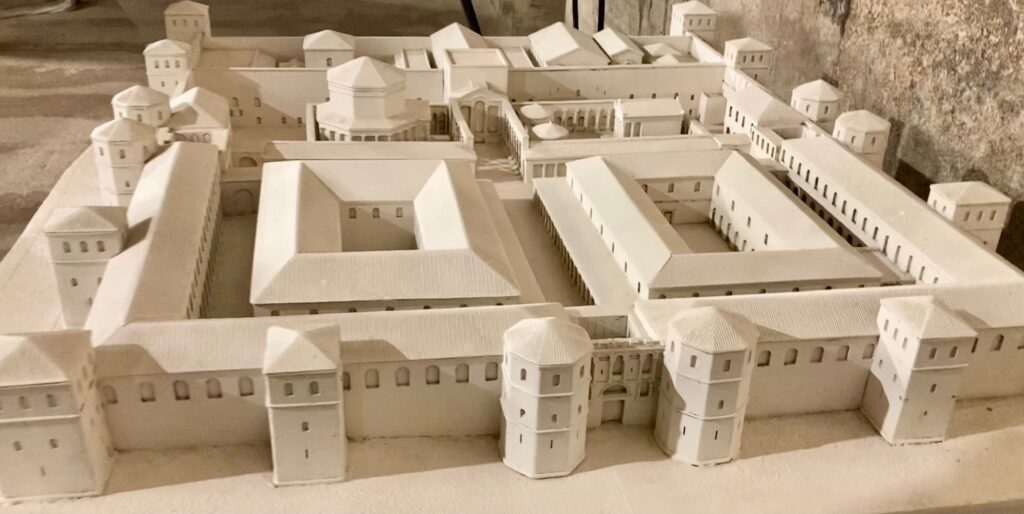
The vast complex of vaulted basements under Emperor Diocletian’s Palace, Split, Croatia, built 295-305 AD, were for centuries used as a medieval sewer and dumping ground, but now they are cleaned up and together with the surviving Roman buildings above ground, they have helped to inform a reconstruction of what the Emperor’s palace looked like.
You can now experience how the palace looked and worked, and most of it is free to enter.
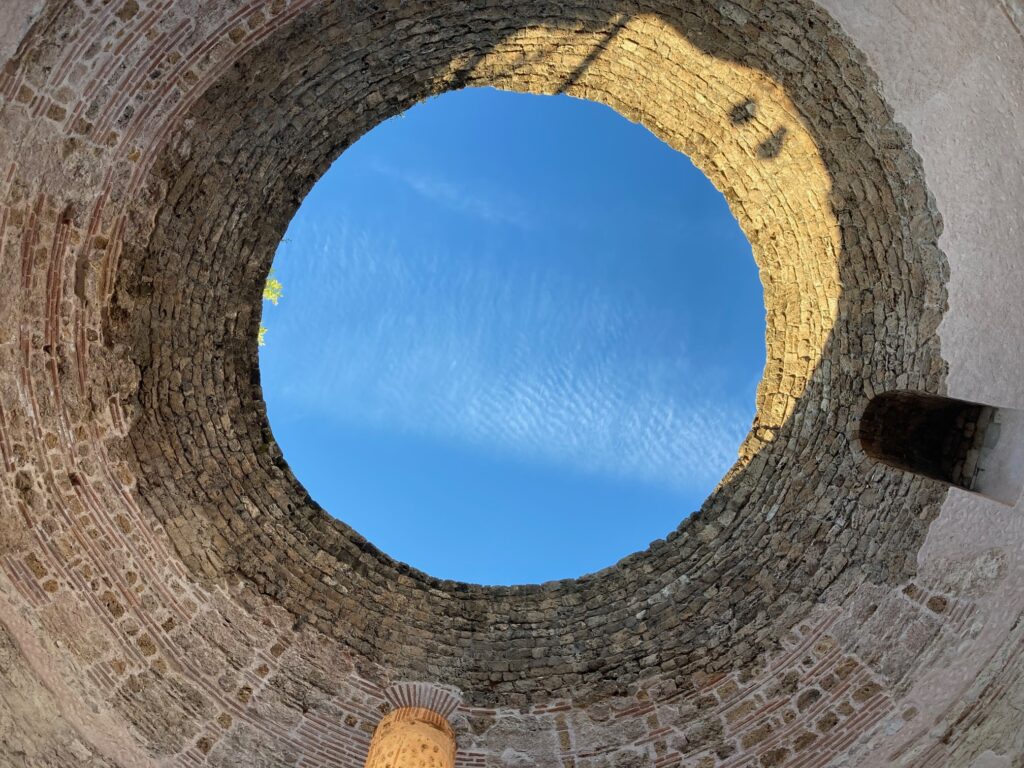
Entrance to the Temple of Jupiter, Diocletian Palace, Split, Croatia, studied by Robert Adam in the eighteenth century, it inspired his Classical Revival in England, Scotland, and across Europe and North America.Looking skywards where originally a dome existed above the vestibule where dignitaries waited for their audience with the Emperor.The Forum, within Diocletian’s Palace. Diocletian’s mausoleum is on the left, (one of the world’s oldest churches) and his apartments are straight ahead. The 3,500 year old Syphynx and red stone columns taken from Egypt by Roman Emperor Diocletian, over 1,700 years ago, for his palace at Split, in modern day Croatia.Another 3,500 year old Syphynx taken from Egypt by Roman Emperor Diocletian, over 1,700 years ago, for his palace at Split, Croatia, but this one was vandalised and the head now protrudes from a medieval house built within the palace confines. Roman pavements from the third century AD within Diocletian’s Palace, and never a tarmac repair. Part of the vast complex of remarkably well-preserved vaulted basement under Diocletian’s Palace, Split, Croatia, built 295-305 AD.A model of Diocletian’s Palace, Split, Croatia, 295-305 AD.